Background
I’ve been using the excellent
lazy.nvim
package manager for more than three years now, and I’ve been super happy with
it. But with Neovim v0.12.0, vim.pack was shipped: a built-in (but still
experimental) plugin manager that manages plugins using Git, with no third-party
dependencies required, implemented by
Evgeni Chasnovski (see
neovim/neovim#34009), known for
his work on
mini.nvim. This piqued my
interest, as I’ve found myself creating abstractions and isolations with
lazy.nvim that don’t harmonize with my
grug brain. So I
figured I wanted to see if I could simplify by moving onto vim.pack.
If you, like me, have a good deal of plugins installed, you might miss out-of-the-box features from lazy.nvim such as lazy-loading, defining load order of plugins while passing around opts from plugin to plugin, build commands, per-project overrides, ease of management via a nice TUI, local plugin development. This blog post aims to outline what I’ve done in my personal Neovim config to solve all this with minimal helpers.
One caveat though; I realized I don’t want to pass opts between plugins. I can just inline everything into each plugin’s opts most of the time and it’s fine and simple. But I only came to this conclusion after first having solved that, so if you have this as a requirement, I will cover it below.
Jump straight to the summary if you just want the TL;DR. Or strap in for one deep rabbit hole!
Quick intro to vim.pack
Evgeni has written
A guide to vim.pack -
also comes with a nice
YouTube video. But in short:
In Neovim, plugins are stored in a dedicated directory — site/pack/core/opt
under Neovim’s data path — and a lockfile (nvim-pack-lock.json) in your config
directory tracks exact revisions. The API is intentionally small:
vim.pack.add(), vim.pack.update(), vim.pack.del(), and vim.pack.get().
There are no user commands and no TUI from the get-go.
A minimal setup might look like this:
-- init.lua
vim.pack.add({
  { src = "https://github.com/lewis6991/gitsigns.nvim" },
  { src = "https://github.com/hat0uma/csvview.nvim", version = "main" },
  { src = "https://github.com/Saghen/blink.cmp", version = vim.version.range("1.*") },
})
The full reference is available in :h vim.pack or in the
online docs.
On first start, Neovim clones missing plugins and makes them available
immediately after the add() call returns.
Cheat sheet
When running vim.pack.update(), Neovim opens a confirmation buffer with
built-in LSP features for managing individual plugins:
]]and[[to navigate between plugin sectionsgO(:h vim.lsp.buf.document_symbol()) to list all pluginsK(:h vim.lsp.buf.hover()) to show details about a pending change or newer taggra(:h vim.lsp.buf.code_action()) to update, skip, or delete individual plugins
Confirm all updates with :w, or discard with :q.
Syncing across machines: put nvim-pack-lock.json under version control.
On a secondary machine, pull the lockfile, :restart Neovim (new plugins are
installed automatically), then run
vim.pack.update(nil, { target = 'lockfile' }) to align all plugins to the
lockfile’s revisions. Plugins removed from the lockfile can be cleaned up with
vim.pack.del().
Reverting an update: revert the lockfile (e.g.
git checkout HEAD -- nvim-pack-lock.json), :restart, and run
vim.pack.update({ 'plugin' }, { offline = true, target = 'lockfile' }) to
roll back to the previous revision.
Lazy-loading capabilities of vim.pack
In essence, what we are talking about here is we want to defer e.g. expensive
require() calls or heavy work carried out by the plugin, for later, when
Neovim has “fully started up”. This is the ever-lasting pursuit of making your
Neovim setup not showing any tangible delay to get to the welcome screen, which
puts your vscode-using colleagues in awe. 😉
Neovim’s stance on lazy-loading of plugins
Neovim’s own plugin development guide (:h lua-plugin,
online) is
very clear on this (and has implementation examples):
QuotePlugins should arrange their “lazy” behavior once, instead of expecting every user to micromanage it.
In other words, a well-written plugin already defers its heavy work internally.
That said, not all plugins are born equal and vim.pack offers no easy-to-use
lazy-loading machinery of its own. So if you want to control startup timing with
vim.pack, you have to wire it up yourself.
What can vim.pack do out of the box?
vim.pack.add() accepts a load option that controls whether and how plugin
scripts are sourced after installation:
load value | What happens |
|---|---|
true | Runs :packadd — adds the plugin to the runtime path and sources its plugin/ and ftdetect/ scripts immediately. |
false | Runs :packadd! — adds the plugin to the runtime path but does not source plugin/ or ftdetect/ scripts right now (see caveat below). |
function | vim.pack does nothing; your function receives { spec, path } and is fully responsible for loading the plugin however you see fit. |
The default depends on when add() is called. Internally, vim.pack checks
v:vim_did_init — a variable that is 0 during init.lua and exrc sourcing
(steps 7b–7c of :h initialization,
online) and flips to
1 at step 10, before plugin/ files are sourced at step 11. So the default
is false only inside init.lua and .nvim.lua (exrc), and true everywhere
else — including plugin/ files, autocmd callbacks, and interactive use. 😵💫
Gotcha!
load = falsedoes not always mean “never load”. During startup,:packadd!defers sourcing to the load-plugins phase (step 11 of:h initialization). Since the plugin is now on the runtime path, Neovim’s normal startup walks it and sourcesplugin/files anyway. Soload = falseininit.luaonly avoids eagerly sourcing — the scripts still run moments later at step 11.But here’s the real gotcha: after startup (e.g. in an autocmd callback),
load = falsegenuinely prevents sourcing, because the load-plugins phase has already passed and won’t run again. 🤯
Remember, vim.pack is a library, not a framework (like lazy.nvim is), so we
shouldn’t expect the same kind of UX. But still, I don’t think this is easy for
most Neovim users to fully grok.
Finding the right pattern
It was somewhere around this point I was wondering if it was really worth my
time to try and port my config from lazy.nvim into vim.pack yet, or maybe wait
until a future release which would bring a more user-friendly API. However, I’m
blessed with the deadly combo of curiosity and stubbornness, so I pressed on
with the perhaps naive viewpoint that plugins should follow best practices. If
not, we could open issues or PRs to fix it.
It took some time back and forth of fiddling and trying things out, but I landed on this:
Fredrik’svim.packpattern
- All plugins should be assumed to use
load = true, unless specifically instructed otherwise. This is what the plugin author intended.- All plugins reside under the Neovim config’s
plugin/folder.- For lazy-loading, wrap
vim.pack.addalong with all other configuration for a given plugin in aVimEnterautocmd, unless it needs to load eagerly (colorscheme, dashboard etc).- Write to a
_G.Config“registry” beforeVimEnterwhich can store global states, plugin opts etc. Once plugins have loaded afterVimEnter, they can read from the shared states in the registry, thus enabling cross-plugin opts sharing.- For per-project overrides, collect them “
exrc-style”, but execute them after all plugins have loaded.
This reduces much of the vim.pack loading complexity down to a “simple” mental
model.
Lazy-loading
By deferring most of all plugin sourcing onto the VimEnter event, the startup
of Neovim becomes very snappy. A small
lazyload.lua
module handles this with two queues — VimEnter and an override queue — each
draining in order:
lua/lazyload.lua
lua/lazyload.lualocal M = {}
local vim_enter_queue = {}
local override_queue = {}
local function drain(queue)
for _, entry in ipairs(queue) do
if not entry.sync then
vim.schedule(entry.fn)
end
end
for _, entry in ipairs(queue) do
if entry.sync then
entry.fn()
end
end
end
local function drain_override()
if not override_queue then return end
for _, entry in ipairs(override_queue) do
vim.schedule(function()
local ok, err = pcall(entry.fn)
if not ok then
vim.notify((".nvim.lua override error:\n%s"):format(err), vim.log.levels.ERROR)
end
end)
end
override_queue = nil
end
vim.api.nvim_create_autocmd("VimEnter", {
once = true,
callback = function()
drain(vim_enter_queue)
vim_enter_queue = nil
drain_override()
end,
})
function M.on_vim_enter(fn, opts)
local sync = opts and opts.sync or false
if vim_enter_queue then
table.insert(vim_enter_queue, { fn = fn, sync = sync })
elseif sync then
fn()
else
vim.schedule(fn)
end
end
function M.on_override(fn)
if override_queue then
table.insert(override_queue, { fn = fn })
else
vim.schedule(fn)
end
end
return Mdrain() does two passes: first it schedules async callbacks via
vim.schedule(), then it runs synchronous ones. Callbacks are async by default
— pass { sync = true } for the rare plugin that must be fully set up before
the UI draws (like a statusline).
The execution order is: VimEnter sync → VimEnter async → overrides. Since
vim.schedule is FIFO, overrides always run last — which is what makes
per-project overrides (covered later) work.
Then you defer the plugin from loading and setting up like so:
-- plugin/<name>.lua
require("lazyload").on_vim_enter(function()
  -- build command on plugin install/update
  vim.api.nvim_create_autocmd("PackChanged", { ... })

  -- add plugin
  vim.pack.add(...)

  -- configure plugin
  require("plugin").setup({ ... })

  -- keymaps
  vim.keymap.set( ... )
end)
VimEnter fires after all
plugin/ files have been sourced. See :h autocmd.txt
online for all available events.
Callbacks registered after VimEnter has already fired execute immediately (or
via vim.schedule for async), so this pattern is safe to use from any plugin/
file regardless of load order.
NoteThings like colorschemes and a startup dashboard should not be lazy-loaded via
on_vim_enter.
Passing opts from one plugin to another
In lazy.nvim, any plugin spec can declare a dependency and pass opts into it. lazy.nvim deep-merges all contributions automatically. For example, mason can add itself to lualine’s extensions list while also passing opts to itself:
-- lazy.nvim style
return {
  "mason-org/mason.nvim",
  dependencies = {
    {
      "nvim-lualine/lualine.nvim",
      opts = {
        extensions = { "mason" },
      },
    },
  },
  opts = { PATH = "append" },
}WarningSystematic cross-plugin opts merging is arguably an anti-pattern in traditional Neovim idioms. From what I know, it originated with lazy.nvim + LazyVim and was designed with a distro in mind, where plugins could be cherry-picked by the user. Neovim’s own
vim.lsp.config()uses a similar layered merge, but scoped to a single subsystem — not one plugin reaching into another’s config.That said, the decentralized approach is appealing to me, compared to tangling plugin configurations up in each other. But it comes at a cost; abstractions and complexity. And since I’m writing a personal Neovim config (not a distro), I here prefer simplicity and explicitness over complexity and implicitness. So, I’ve actually opted for not doing this. I will, however, continue explaining how my setup supports it together with using
vim.pack.
So, with vim.pack, there is no dependency graph and no automatic opts merging.
Every plugin/ file is self-contained and loads in alphabetical order. How can
we achieve this behavior without lazy.nvim?
I solved this with a small shared global config “registry” that acts as a
central coordination point. Plugin files register data into it immediately
on load of plugin/**/*.lua, and the same plugin files can also read from
it in deferred callbacks, after all files have had their chance to contribute.
Let’s look at the registry:
-- init.lua
local merge = require("merge")

_G.Config = {
  lsp = {},
  mason = {},
  conform = {},
  lint = {},
  lualine = {},
  -- ... other fields
}

function _G.Config.add(spec)
  merge(_G.Config, spec)
end
Each plugin gets its own namespace (“lsp”, “mason”, “conform” …). Plugins with
a setup(opts) function store their opts under .opts, while other data (like
mason.ensure_installed or lsp.servers) lives alongside it.
The merge() function is a custom deep merge that appends lists (instead of
replacing them like vim.tbl_deep_extend does) and recurses into dicts:
-- lua/merge.lua
local function merge(base, override)
  for k, v in pairs(override) do
    if v == vim.NIL then
      base[k] = nil
    elseif type(v) == "table" then
      local bv = base[k]
      if type(bv) ~= "table" then
        base[k] = v
      elseif vim.islist(v) then
        for _, item in ipairs(v) do
          if type(item) == "table" or not vim.list_contains(bv, item) then
            table.insert(bv, item)
          end
        end
      else
        merge(bv, v)
      end
    else
      base[k] = v
    end
  end
  return base
end

return merge
This is the key difference from vim.tbl_deep_extend("force", ...): when two
plugins both contribute to the same list (say, both add mason tools), the items
are appended and deduplicated instead of the second one silently replacing the
first. And vim.NIL lets you explicitly remove a key — useful in project-local
overrides where you want to disable something a lang file declared:
Config.add({
  lint = { linters_by_ft = { go = vim.NIL } },
})
Now any plugin file can contribute data to any other plugin — regardless of
alphabetical load order — because all contributions happen at load time
(immediate), and all consumption is deferred (VimEnter).
Mason contributes its lualine extension and reads its own opts from the registry:
-- plugin/mason.lua

Config.add({
  lualine = { opts = { extensions = { "mason" } } },
})

require("lazyload").on_vim_enter(function()
  vim.pack.add({
    { src = "https://github.com/mason-org/mason.nvim" },
  })

  local merge = require("merge")

  local opts = { PATH = "append" }
  merge(opts, Config.mason.opts or {})
  require("mason").setup(opts)
end)
Lualine reads everything that was contributed:
-- plugin/lualine.lua

require("lazyload").on_vim_enter(function()
  vim.pack.add({
    { src = "https://github.com/nvim-lualine/lualine.nvim" },
  })

  local merge = require("merge")

  local opts = { extensions = { "man", "quickfix" } }
  merge(opts, Config.lualine.opts or {})
  require("lualine").setup(opts)
end)
Build command
Some plugins need a build step after install or update, like compiling a binary,
downloading assets, or updating parsers. In lazy.nvim this is the build key.
With vim.pack, the equivalent is the PackChanged autocmd event.
PackChanged fires after a plugin’s state has changed. The event data includes:
ev.data.kind—"install","update", or"delete"ev.data.spec— the plugin’s full spec (including.name)ev.data.path— full path to the plugin directory
Here’s how nvim-treesitter’s :TSUpdate maps to a PackChanged hook:
-- plugin/nvim_treesiter.lua
require("lazyload").on_vim_enter(function()
  vim.api.nvim_create_autocmd("PackChanged", {
    callback = function(ev)
      if ev.data.spec.name == "nvim-treesitter" then
        vim.cmd("TSUpdate")
      end
    end,
  })

  vim.pack.add({
    { src = "https://github.com/nvim-treesitter/nvim-treesitter", branch = "main" },
  })
end)
Local plugin development
When developing Neovim plugins, it’s been really nice to be able to define
dev = true in lazy.nvim, which makes the plugin load from local disk instead
of the remote git repo. We can achieve this quite easily too.
-- lua/dev.lua
local M = {}

function M.prefer_local(local_path, remote_src)
  local expanded = vim.fs.normalize(vim.fn.expand(local_path))
  if vim.uv.fs_stat(expanded) then
    return expanded
  end
  return remote_src
end

return M
Then use it as the src in vim.pack.add:
local dev = require("dev")

vim.pack.add({
  { src = dev.prefer_local("~/code/public/neotest-golang", "https://github.com/fredrikaverpil/neotest-golang") },
})
Per-project overrides
lazy.nvim has .lazy.lua for per-project config. Neovim has built-in exrc
(:h exrc,
online) — drop a
.nvim.lua in your project and Neovim sources it on startup, guarded by a trust
prompt (:h :trust).
Here we can leverage the same capabilities as we have for a plugin; register
data into the _G.Config and lazyload plugins. But we can also perform
per-project overrides, by using the on_override autocmd wrapper. Anything
wrapped in this will be deferred to loading after all plugins have loaded, and
thus provide a “final say”; perfect for per-project settings.
Here’s how I set custom markdown formatting and gopls overrides for a certain
project, by wrapping it all into on_override:
-- ~/code/work/.nvim.lua
require("lazyload").on_override(function()
    -- Override markdown formatter
    require("conform").formatters_by_ft.markdown = { "mdformat" }
    require("conform").formatters.mdformat = {
        prepend_args = { "--number", "--wrap", "80" },
    }

    -- Override gopls settings
    vim.lsp.config.gopls.settings = {
        gopls = {
            analyses = {
                ST1000 = false,
                ST1020 = false,
                ST1021 = false,
            },
        },
    }
end)
A nuance to be aware of here is exrc walks upwards, from $cwd to $HOME.
This means a .nvim.lua in $cwd loads before a .nvim.lua file in $HOME.
I initially built a custom variant of exrc which walked in reverse, but I
dropped it in favour for simplicity (I simply don’t need it).
Summary
Recreating the lazy.nvim features I cared about on top of vim.pack came down
to a handful of small, composable pieces:
- Lazy-loading: Use
lazyload.luato queue setup behindVimEnterfor most plugins (except colorscheme, startup dashboard etc). - Cross-plugin opts: a shared registry that plugin files write to at load
time and read from at deferred setup, paired with a
merge.luahelper that appends+dedups lists instead of replacing them. - Build hooks: the
PackChangedautocmd with a filter onev.data.spec.name. - Local development: a tiny
dev.luahelper that returns a local path when present, falling back to the remote URL — used assrcinvim.pack.add(). - Per-project overrides:
.nvim.luavia built-in exrc ('exrc'), callinglazyload.on_override()to defer execution until after allVimEnterplugin setup.
I keep all these helpers in here.
The property of this design is that registration is immediate and
consumption is deferred. Any plugin/ file can contribute data to any other
plugin regardless of alphabetical load order, because all contributions happen
at load time before any of the consumers read them at VimEnter.
Here’s how it all slots into Neovim’s startup sequence (see :h initialization
online for the full
spec):
| Step | Neovim phase | What this config does |
|---|---|---|
| 7b | init.lua runs | Leader keys, require("options"), diagnostics. |
| 7c | .nvim.lua runs (if 'exrc' is enabled) | Register project-local overrides via require("lazyload").on_override(...). |
| 11 | plugin/**/*.lua loads alphabetically | Each file calls vim.pack.add(), registry.add(), and queues setup via lazyload.on_vim_enter() — or wraps it in a FileType/keymap/command closure. |
| 18 | VimEnter fires | lazyload.lua drains vim_enter_queue (sync inline, async via vim.schedule), then schedules override_queue. |
| later | Scheduler ticks forward | FIFO execution: vim-enter async → project overrides. |
Project-local overrides get the last word — which is the behavior most people intuitively expect from exrc but which Neovim doesn’t provide out of the box.
Future development
So what can we expect from vim.pack, moving forward?
On the topic of providing lazy-loading via vim.pack, the stance by
Justin M. Keyes is good, I think:
QuotePutting that burden on every user, instead of solving it once per plugin, is an anti-feature. Plugins should solve that, users should not have to micro-manage this in their configs. I don’t buy the argument that plugin authors are incapable of this, yet somehow every user is capable of it.
It makes a lot of sense to at least start here.
Libraries to help working with vim.pack
I should mention there are projects which aim to bridge the gap of wanting more
out of vim.pack:
- lumen-oss/lz.n — standalone lazy-loading
library that works with
vim.pack/packadd, providing its own abstraction for loading on events, commands, filetypes, and keymaps. - BirdeeHub/lze — lazy-loading library (not
a plugin manager) that works with
packaddor any plugin manager supporting manual lazy-loading. - zpack.nvim — thin wrapper on top of
vim.packthat adds lazy-loading and lazy.nvim-style declarative specs.
I’m sure someone will build a nice TUI around vim.pack, but in the meantime
I’m using
my own forked variant
of
this TUI, originally built by Andreas Schneider.
Closing comments
I really like how it all came out in the end. It works great for me. That’s all I care about. I now have all capabilities (in some shape or form) that I really liked about lazy.nvim and depended on.
My Vim journey started with a single .vimrc before moving onto Neovim, where I
adopted LazyVim early on. I moved off LazyVim, wrote my own config but with
lazy.nvim as package manager. I borrowed a lot of ideas and code from LazyVim. I
felt I was on a “modern” stack, a modern take on a Neovim config. But when now
looking into adopting vim.pack, I had to read up on how Neovim actually works,
how I’m expected to follow certain idioms, dictated by Neovim itself. I really
feel the change. The config became lighter, much more tidy, less complexity. And
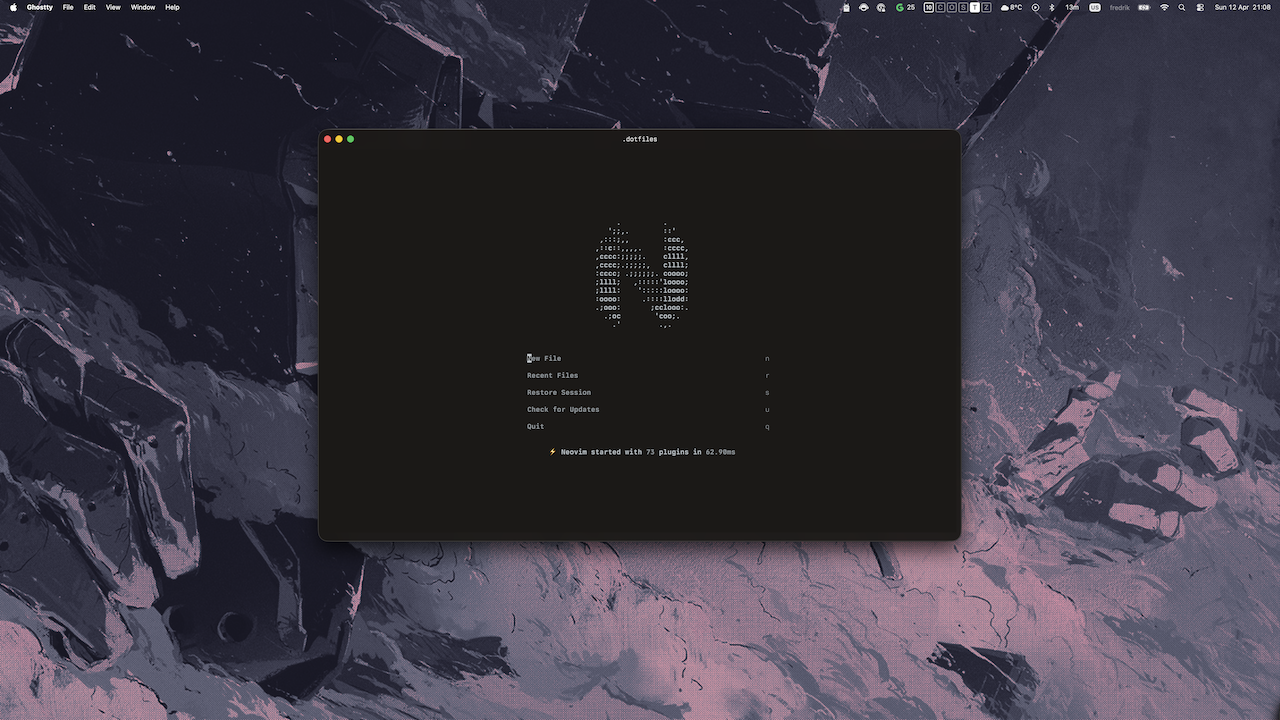
my Neovim config actually starts up faster than with lazy.nvim, in 40ms (at 72
plugins). It feels like I cheated the system, but I’m actually just following
the native idioms now. Well, except for the fact that I load almost everything
on VimEnter, which I’m sure will make some people frown. But who cares; it
works for me.
Before looking into all this, I couldn’t imagine dropping lazy.nvim’s notion of
isolating plugins’ concerns from each other. Like, passing opts between plugins,
so that I could just delete any plugin’s .lua file (or set enabled = false),
and cleanly having removed all of that plugin’s concern from my Neovim config.
When I look at what I have now, with vim.pack and mixed concerns, the config
is a lot leaner, more readable, with much less abstractions. I don’t have to
cater for all the “what ifs” which e.g. the LazyVim distro has to do, as I only
design this for myself. I even ended up not using the capability to pass opts
between plugins even if the mechanism is there, if I ever need it.
But migrating from lazy.nvim to vim.pack honestly took more effort than I
initially expected, for getting my Neovim config into what I would consider an
acceptable state. I wouldn’t recommend most users do this, unless maybe you just
want to adopt something like my approach, or if you like diving into the rabbit
hole and spend hours on making things work. Maybe wait and see how vim.pack
evolves and how others integrate it into their configs before digging in. It’s
still early days.
You can inspect my full Neovim configuration over at my dotfiles.
Oh, and also, did you know lazy.nvim weighs in at almost 3 MB?